In my pre-PACSCL life, my archives career focused heavily on institutional records -- in particular, processing medium to large collections of institutional records. I processed the records of university presidents, museum administrators, heads of non-profit organizations, school deans, and (in some of the most dreary processing of my career), administrative records of the financial aid office. It wasn't uncommon to be processing 100+ foot collections several times a year, and to view nearly anything under five feet as a lower priority since it could be tackled "anytime."
Moving to PACSCL and the unprocessed and underprocessed collections of the 22 institutions participating in this project, I've come to a major shift in my assumptions about what's a significant enough body of material to survey. When I visit institutions, it often turns out that they have a rather good handle on their larger collections - it's the small stuff that's giving them fits.
A lot of what we've surveyed is small, by pretty much any definition. Of the 1,078 collections surveyed as of today, 717 are under 5 feet -- and a staggering 400 of those are under 1 foot. And surveying really does seem to be beneficial for these types of materials.
This is because there are two main aims for the surveying. One is to assist with
internal control and prioritization of collections, both within and across institutions. The other is to improve intellectual access to collections. When we survey small collections, the benefit is largely in the second category. The survey record provides a collection-level description that can be used to create a MARC record, an EAD finding aid, or even a simple printout to put in a binder. The distance from our survey collection-level description to the description for a "fully processed" version of these collections tends to be much shorter than for larger collections (in fact, some participants tell us they consider our survey records for these types of collections pretty much final).
It seems there's a growing recognition of the benefits of applying archival standards and methods to processing and cataloging small collections. One sign of this is a new workshop offered by the Society of American Archivists titled "Applying DACS to Single-Item Manuscript Cataloging." I like to think we're a little ahead of the curve on this one!
I was also struck by a post on the Archives and Archivists listserv yesterday about the Alaska and Polar Regions Collections at the University of Alaska Fairbanks designating a "processing day" where all of the staff will work on their backlog of small collections; the idea is that everyone will set aside everything else they're doing and just get through as much as they can. I love this idea - we set aside special days for moves and cleaning out offices, why not do it for increasing access to our collections?
Friday, November 16, 2007
Sweating the small stuff

Friday, October 19, 2007
Klingons at Temple
I'll begin this post with the caveat that I'm not a big science fiction fan and what I don't know about Star Trek and Cons and so on could fill a decent sized library. That being said, one of the sci-fi collections that we surveyed recently at Temple University has really stuck with me. (Temple has a great science fiction collection, by the way, if you're interested. Check out their page describing the Paskow Science Fiction Collection.) The one we looked at the other day is the Sue Frank Klingon/Star Trek collection of fanzines and organizational newsletters. These were assembled by Dr. Frank from groups within and outside of the U.S. -- fan groups are to be found in Britain, New Zealand, and Italy, among other places. The titles include "Klingon Assault Group Force Recon," "The Pillage Voice," "Engage!," "Disruptor," and "Something Else." The newsletters reflect the range of Klingon-related activities afoot in the terran world. They contain drawings, photos, recipes, letters, poems, stories, technical information, and analyses of many aspects of Klingon language and culture. And lots of pearls of information; did you know, for example, that the species of cocoa bean grown on earth is inferior to that grown by the Klingons?
The collection consists of about six linear feet of material, so I'm sure it's just a drop in the bucket of the total Star Trek fan literature that exists in the world. Even so, when you see it all together, it seems like a great resource, both for those looking for the facts and the flavor of Klingon life and for those interested in the phenomenon of Star Trek fandom. What the collection as a whole conveys is the extent to which this piece of popular culture has worked its way into people's everyday lives. It's impossible to tell from the fanzines what proportion of their lives the fans spend as Klingons; I assume that for at least some of the fans, the Klingon identity is pretty central.
At any rate, the production of all this Klingon-related material is a nice illustration of the theme of the "dedicated collector" that crops up again and again in our surveying. (With this collection, I think both Sue Frank and the creators of the fanzines count as dedicated collectors). The collections we see that were created by this kind of devoted, focused person are almost always compelling, if not always as obviously interesting as the Klingon stuff. When a collection is visibly a labor of love, it inspires a certain respect, regardless of the research value of the information contained within.
And for a summary of science fiction collections around the country (including plenty of Star Trek materials), see the Research Resources at AboutSF.
Tuesday, October 16, 2007
I dream of genies
Lately we've been simultaneously surveying at two different sites. While John and Jenny progress through Temple's collections, I've been back at The Historical Society of Pennsylvania, working on collections of the Genealogical Society of Pennsylvania with special guest star David, a reference librarian at HSP. Under the terms of HSP’s strategic alliance with GSP, materials which GSP collected (including several hundred feet of manuscript collections) are now part of HSP's holdings, so we’re surveying the manuscript material to help HSP's staff get a better handle on what's there.
HSP is already a rich source for genealogical and family research and the resources of GSP undoubtedly add to that richness. We've only been at the surveying for a little while, but already we've seen a variety of types of collections that fit under the "genealogy" umbrella, including funeral home records, items related to a Catholic church and cemetery, diaries of a minister recording his responses to personal and world events, and small caches of family papers.
By far the largest category of material, however, is genealogical research, created by people with various purposes: professional genealogists who conducted family research for others, individuals researching their own family connections, individuals interested in the genealogies of great persons like Charlemagne or William the Conqueror. The collections vary quite a bit both in how the research was compiled and how it was presented. Some people created scrapbooks or narrative histories that present a polished final product, while others maintained the research in its raw form. There are transcribed or photocopied extracts from published sources, printouts from microfilm, correspondence that documents the researcher’s inquiries to various libraries and archives, government offices, religious institutions, and personal contacts, pedigree charts, rough notes, and detailed data forms. Sometimes sources are cited, sometimes they're not. Some collections are thoroughly indexed by their creator or by volunteers at the society, while others are so idiosyncratic that at first glance their method seems decipherable only by their creator.
These collections provoke a number of questions when it comes to assessing research value. What do measures like "documentation quality" and "interest" mean when what is being assessed is someone's research using primary sources, rather than the sources themselves? We know that genealogy itself is a high interest topic; some sources claim that genealogy is now the second most popular hobby in the United States. (Even though some dispute the accuracy of these claims, anecdotal evidence and the success of services like Ancestry.com clearly points to a large segment of the population being interested in tracing its roots.) But how are genealogical research materials in archives used by researchers other than the person who created them – and how likely are they to be used? While each collection has a fairly narrow focus, does its value exponentially increase when added to an accumulation of similar materials in a place like HSP? Is this a category of material where the whole is greater than the sum of its parts?
Taking a slightly broader perspective, in addition to the genealogical content of these collections, do they tell us something about the nature of genealogical research? There’s a small but growing body of archival literature on the information seeking behavior of genealogists. For example, see Wendy Duff and Catherine A. Johnson's 2003 article from the American Archivist titled "Where is the list with all the names? Information-seeking behavior of genealogists" (soon to be available online, but currently print only) or Elizabeth Yakel's "Seeking information, seeking connections, seeking meaning: genealogists and family historians" from Information Research. These studies used interviews with and observation of individual genealogists to ferret out details of their research methods, but might an examination of those methods as exhibited in the collections they create also be useful?
Given that we still have over a hundred collections to survey, we'll be grappling with these questions for awhile. We have colleagues onsite here at HSP and GSP whose expertise will be invaluable, but I'd be interested to hear from other people who collect or access genealogical research materials about how such collections are used once they've passed from their creator into a repository.
Tuesday, October 2, 2007
Chess by telegraph, Quaker golfers, and Philadelphia numismatists...
Is this the answer to a Carnac riddle?* Possibly, but it's also a sampling of the subjects of collections you might uncover when searching our database of unprocessed and underprocessed collections. These are the results of a search for collections related to the PACSCL-designated theme "Leisure activities" (full results can be viewed here), but there are plenty more waiting to be found. Our database currently features 1,000 collections from eight repositories, and more collections and institutions will be added regularly.
This database is the first step of many toward improving physical and intellectual access to the collections surveyed for this project. It's also our small contribution to the increasing push in the archives and special collections community to provide researchers with information about our collections -- both processed and unprocessed -- in a timely fashion.
There are a number of other interesting approaches to providing information on unprocessed collections. For example, Yale University’s Beinecke Library has a searchable database of uncataloged acquisitions online, and its blogs often highlight particular collections from this queue.
The American Heritage Center, under the leadership of Mark Greene of "More Product, Less Process" fame, undertook a massive reevaluation of its holdings (the majority of which were unprocessed) and created MARC records in OCLC’s WorldCat for all the collections it decided to retain (you can read a press release about this project at here).
Princeton University's Mudd Manuscript Library provides multiple access points for both unprocessed and processed collections; within the last eighteen months, the staff have created collection-level MARC records for every previously uncataloged archival collection in its holdings, then used the freeware program MarcEdit to convert them to collection-level EAD finding aids that are web discoverable, like this one. The catalog records go into Princeton’s online catalog and Worldcat, and the finding aids are contributed to Princeton’s own EAD website and OCLC’s ArchiveGrid.
Lastly, but certainly not leastly, our very own University of Delaware provides preliminary descriptions of many of its unprocessed collections and lists them on its manuscript collections web page (see one for landscape architect Armistead W. Browning Jr. here). It's a simple, but effective, way of calling researchers' attention to these collections' existence.
Telling the world about our unprocessed collections is certainly not without its challenges, but our researchers will certainly benefit from it, and I’m confident that we will too.
* Yes, I know this is an incredibly dated reference, but even more than 15 years after Johnny Carson vacated the airwaves, there’s still no more recognizable trope for linking seemingly unrelated items!
Thursday, September 27, 2007
If it's Thursday, this must be Temple
We've just started at our next site, Temple University’s Special Collections. Subject matter-wise, it's one of the more abrupt shifts in the project: after nearly two months at the Academy of Natural Sciences surveying the papers of ornithologists, malacologists, ichthyologists, paleontologists, and just about every other flavor of natural history "-ologist" you can think of, we're now immersed in the records of leftist and counterculture organizations like the Socialist Review and Liberation News Service, among other topics.
This is also the first place we've been where a significant number of the collections we’re surveying are housed offsite. (Luckily for us, "offsite" in this case means a building that's a five-minute walk from the main library, so we can still avail ourselves of Temple's many food trucks.) The warehouse doesn't quite have the rarified atmosphere of some of our other stops, or one that conforms to the idealized representations of archives in movies and literature as quiet, dark-paneled nooks -- it's kind of like working at Home Depot, except that instead of 2' x 4's and plumbing fixtures there are boxes upon boxes of incredible manuscript collections.
I think this kind of shifting – of atmosphere, of subject matter, of routines, of personalities – is beneficial to us and to the project in a lot of ways. It shakes up our preconceived notions and we get to observe all the different ways people do things, benefit from their differing perspectives on many of the same types of issues, and understand why they collect what they collect. If we got too entrenched at one place, we might start to see things through only one lens, or expect things to work only a certain way. (Of course, one doesn't need to physically change sites as often as we do to maintain perspective; mental shifts – accomplished by going to a conference, visiting a colleague’s repository, or keeping up on professional literature and listservs – go a long way.)
It certainly isn't as comfortable as coming in to the same desk, coffee cup, and co-worker faces every morning, but it definitely makes us informed about (and open to) the complexities of our field, which should help us keep complacency at bay when we eventually settle back into a less nomadic work existence.
Monday, September 10, 2007
Taking the show on the road
I just returned to the office after a couple weeks away for various professional and personal activities. The major professional activity was attending the Society of American Archivists conference in Chicago, where I exhibited a poster on the survey project (captured in miniature below – please click and save it if you’d like to see it in its full 44" x 28" glory).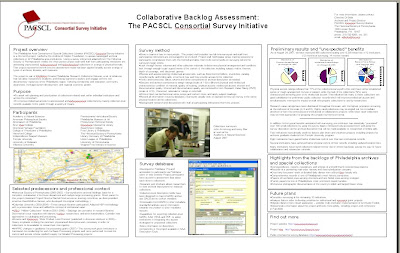
I gathered up a raft of business cards and talked with lots of people about their particular collection situations. Both coasts are represented in my followup pile, as are a number of the states in between. There are plenty of university archives and academic special collections in there, but also private historical societies, museums, religious institutions, schools, professional organizations and a funding agency.
Talking with people at SAA emphasized to me once again the similarity in the issues so many of us in archives and special collections face, regardless of the types of institutions we work in, the kinds of collections we hold, or how long our programs have been around. In some ways this can be a touch disheartening – if so many of our issues are so common, shouldn’t we have figured out some kind of solution by now? – but in many more ways it’s very encouraging, because it means we can learn from and help each other.
Special thanks to everyone who stopped by, and to John and Jenny for continuing to work down the mountain of Philadelphia area surveying while I was in the Midwest.
Wednesday, August 15, 2007
The heretofore undiscovered link between surveying and hoboing
Is there any word in the English language more amusingly evocative than "hobo"? (And, by logical conclusion, is "hoboing" English's funniest gerund?)
Lest you think this an idle query with no survey content, let me tell you what prompted this train of thought. On Friday we surveyed a collection of notebooks from an amateur ornithologist who was active from the 1920s to the 1980s. This, in itself, is not unusual, since the archives of the Academy of Natural Sciences are replete with birding documentation, ranging from daily checklists of birds seen to highly detailed species and location descriptions to anatomically correct drawings to tens of thousands of photographs and slides.
What was unusual about this collection was that, along with the checklists and the decades worth of notebooks chronicling sightings throughout the United States, Europe, South America, and Africa, were journal entries in which the author chronicled his "hoboing" adventures -- hitching rides with strangers, making camp with wizened oldtimers, getting rounded up by the police -- all undertaken in pursuit of his birding passion. This presented a whole different face to hoboing and, probably needless to say, prompted a weekend's worth of hobo-related google searches.
Speaking of faces and hoboing, here's a link to a wonderfully diverting site where you can browse through visual depictions of "the" 700 Hobo Names, as authoritatively declared by John Hodgman in his book The Areas of My Expertise.
